
Meet Van Eyck’s extraordinary faces at London’s National Gallery
 by
Babylon Radio
Listen nowA glance, a folded sleeve, a tiny reflection in a mirror: Jan van Eyck’s portraits reward attention to things that are easy to miss. From 21 November 2026, London’s National Gallery brings his nine known painted portraits together in one exhibition. For a winter afternoon, it offers an unusually concentrated encounter with faces made almost six centuries ago, and a good reason to put familiar reproductions aside and look again.
Nine portraits, new conversations
Van Eyck: The Portraits runs until 11 April 2027 in the Ground Floor Galleries. Loans from European collections join the Gallery’s own paintings, bringing together around half of Van Eyck’s surviving autograph works. The sitters include merchants, craftsmen and members of his family, rather than a procession of rulers alone.
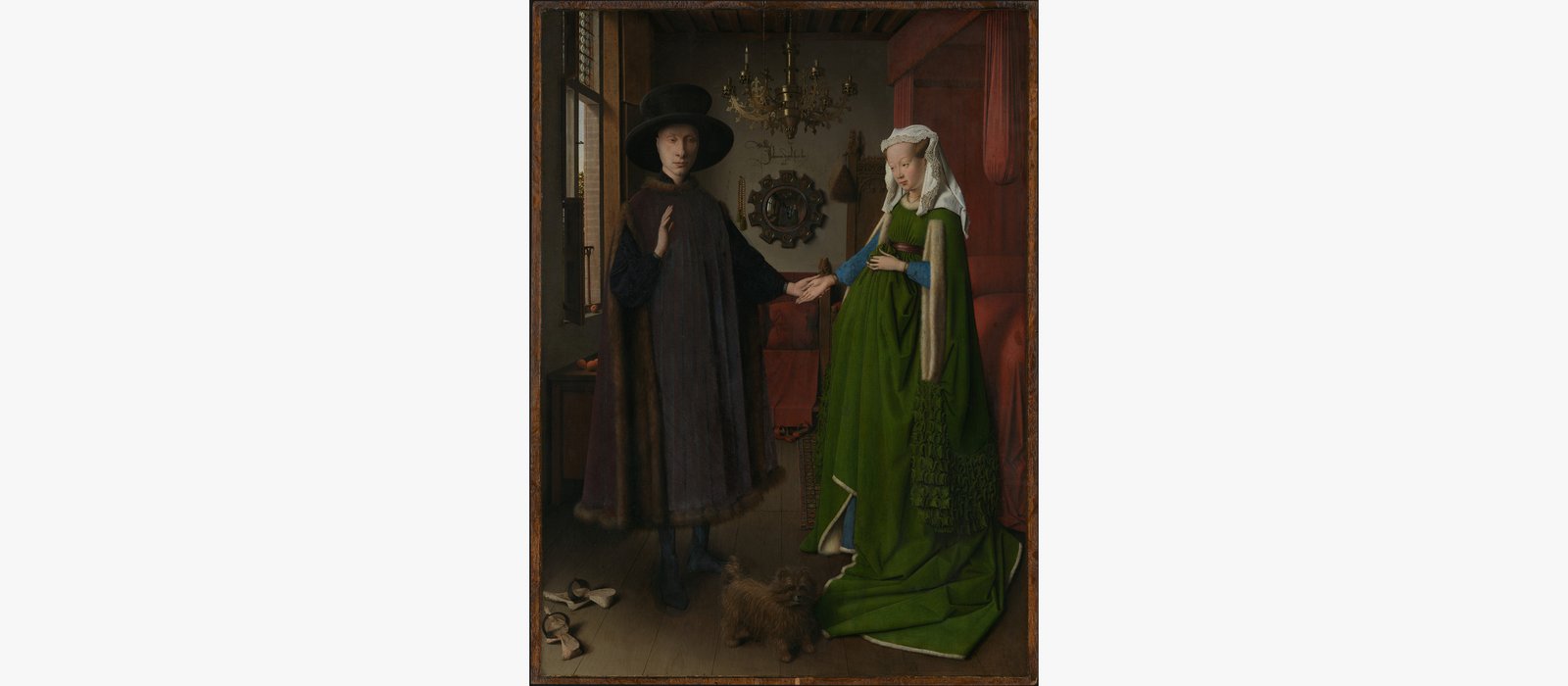
The gathering creates comparisons that a single collection cannot offer. The exhibition announcement pairs the familiar Arnolfini Portrait with a smaller Berlin portrait of a man who may be Giovanni Arnolfini. The newly conserved Portrait of a Man (Self Portrait?) will also appear beside the portrait of Van Eyck’s wife, Margaret, lent from Bruges. Looking between them becomes part of the visit, not simply a way of moving on to the next label.
Start with the room, then find the people
The Arnolfini Portrait, painted in 1434, invites that slower approach. The green dress spreads towards the floor; a small dog stands near the couple’s feet; a chandelier hangs above them. Look from the broad areas of colour towards the little convex mirror on the rear wall, where the space seems to open again.
The Gallery identifies the man as probably Giovanni di Nicolao di Arnolfini, an Italian merchant living in Bruges, with his wife. That qualification matters: recognising a famous picture is not the same as knowing everything about its people. The room is understood as a reception room, and the painting is no longer generally read as a record of a marriage ceremony.
Try following a single material across the picture: fur, polished metal, glass or cloth. Each changes how light appears to behave. Then return to the joined hands and the faces. The furniture and possessions draw the eye outward, but the meeting between two people holds the composition together.
Follow a gaze across six centuries
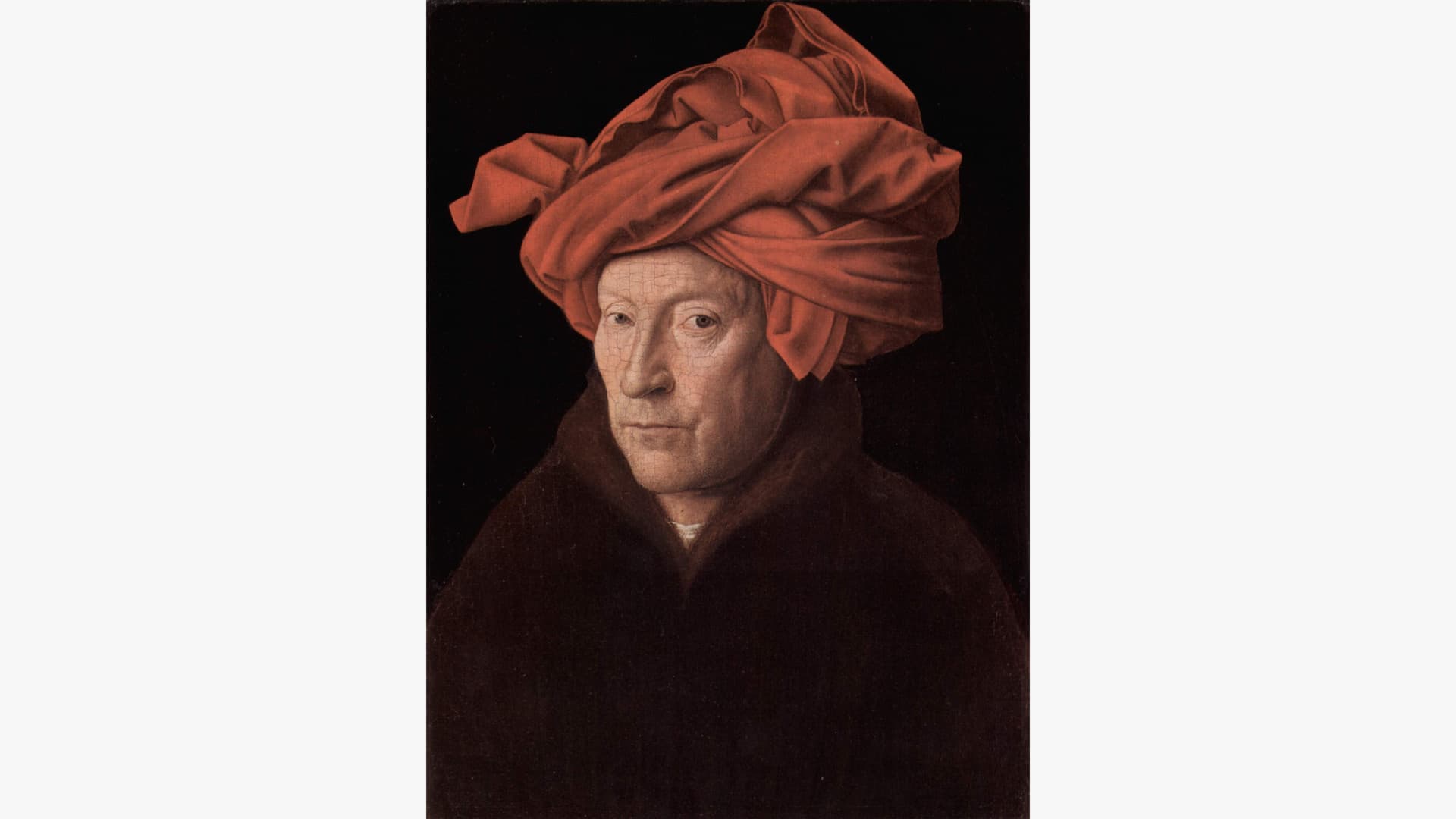
In Portrait of a Man (Self Portrait?), the encounter is more direct. A red headdress rises against a dark background while the sitter looks towards the viewer. The Gallery considers this almost certainly Van Eyck himself, although the question mark remains in the title. His headwear is a chaperon, not the turban sometimes used in the painting’s older name.
The realism is also a series of painterly decisions. The Gallery explains that tiny touches of brown and white, with blue mixed into some highlights, create the sitter’s stubble. His head is enlarged against narrow shoulders. Noticing those choices shifts the experience from recognising a face to watching an artist construct its presence: convincing likeness and carefully arranged illusion belong to the same picture.
The folds are an absorbing place to begin, before moving to the closely observed face. The painting’s frame carries the artist’s motto and a date in October 1433, making the object around the image part of its meaning too. Our archival reproduction shows the painted image without that frame and predates the recent conservation.
Make an afternoon of looking
Standard exhibition admission is £18, including an audio guide; visitors under 18 enter free. This is a paid exhibition within a gallery whose general collection admission is free, so select the exhibition ticket rather than assuming a general visit covers it.
The visitor guide directs visitors to the Sainsbury Wing entrance on Trafalgar Square. Published opening hours are 10am–6pm daily, extending to 9pm on Fridays. The Gallery closes on 24–26 December and 1 January. Choose a date within the exhibition’s run and leave room afterwards to return to whichever face stayed with you.
Jan van Eyck, The Arnolfini Portrait, 1434, National Gallery, London, public domain. Jan van Eyck, Portrait of a Man (Self Portrait?), 1433, National Gallery, London, public domain; archival reproduction without the frame, predating the recent conservation. Both works are shown in full and letterboxed for display.