
Look beyond the figures: a new way to explore Madrid’s Prado
 by
Babylon Radio
Listen nowA bridge can be the least noticed thing in a painting. Your eye follows a face, a bright sleeve or a crowd, while the structure carrying people across the water becomes background. A new route through Madrid’s Museo Nacional del Prado invites visitors to reverse that habit and give the built world a little more attention.
Engineering at the Prado: A Bridge Between Art and Technology opened on 26 October 2026 and continues until 21 February 2027. Developed with Fundación FHECOR, it brings together 29 works already displayed in the collection. Think of it as a different way to navigate the museum, rather than a separate room of newly arrived loans.
A route for curious eyes
The project’s curators, Francisco Javier Fernández Pozuelo and Francisco Javier León González, have chosen works that reveal engineering in different roles. Sometimes a bridge commands the picture. Elsewhere, a harbour or an engineered landscape supports a scene whose principal subject seems to lie somewhere else.
The useful part for a visitor is that you do not need technical training to begin. Ask where people could cross a river, how boats might approach a shore, or what links the foreground to a distant town. These are questions about how an image works as much as how a structure works. They can make an unfamiliar painting approachable without reducing it to a diagram.
- For a wider introduction to the city around the museum, explore the Madrid section of our Spain neighbourhood guide.
A visit with a friend offers another possibility: each choose the detail you noticed first, then exchange discoveries. You may find yourselves looking at the same canvas in quite different ways.
Goya’s Madrid beyond the picnic
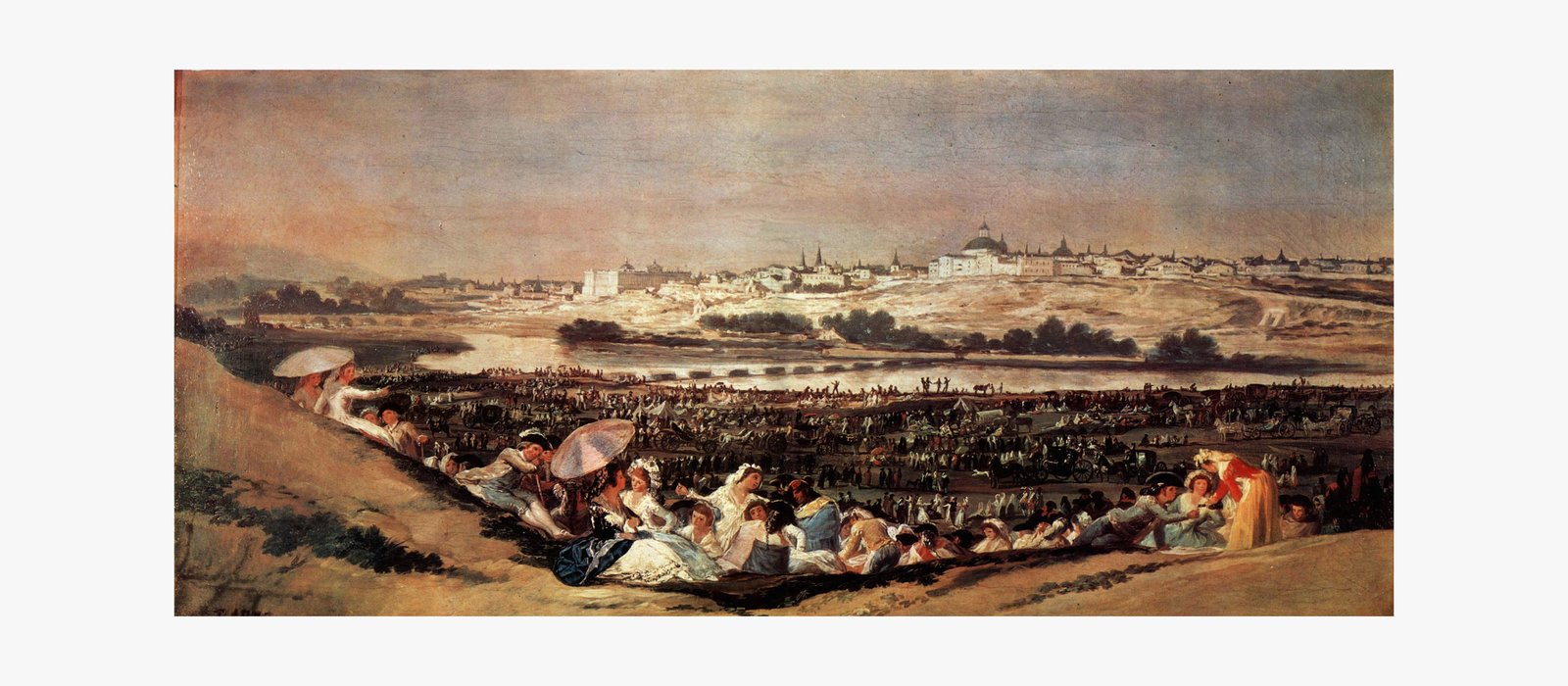
Francisco de Goya’s The San Isidro Meadow, painted in 1788, makes a rewarding starting point. In its wide composition, people occupy the sloping foreground while the city stretches across the far side of the water. The gathering is full of small encounters, but the setting also gives the scene its sense of scale.
Try letting your eye travel beyond the clothes and parasols. Follow the river horizontally, then return to the people closest to you. The distance between those two zones turns a crowded outing into a view of a larger urban world. It is possible to enjoy the sociability of the scene and still ask what makes this meeting place accessible.
The route’s leaflet places the painting in room 20. Keep its small physical size in mind: the catalogue dimensions are 44 by 94 centimetres. This expansive view is not an enormous canvas.
A bridge through Mantegna’s window
Andrea Mantegna’s The Dormition of the Virgin offers a different viewing exercise. Figures gather in an architectural interior, but the opening behind them reveals water and a long bridge. The religious subject and the landscape remain distinct, while the painting gives both a place within the same carefully organised space.
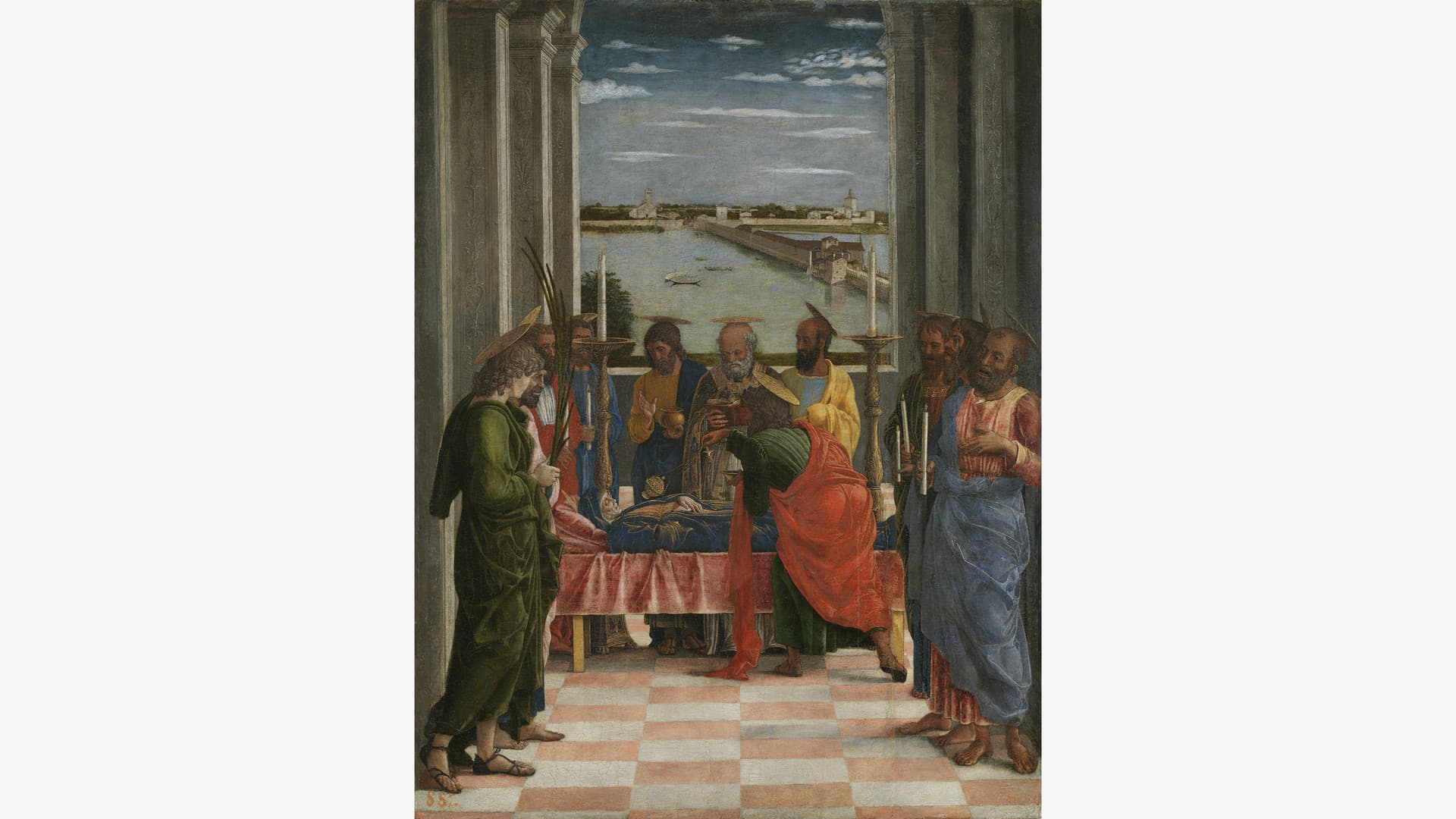
Start with the tiled floor, then look through the central opening. The shift from an enclosed room to an extended view can feel surprisingly dramatic. Here the bridge is not a decorative flourish to identify and forget; looking at it changes the depth and reach of the whole image. The route lists this painting in room 56B.
- For a separate perspective on how museums interpret collections, read our 2021 archive on restitution and repatriation.
Plan a manageable museum visit
Download the museum’s bilingual route leaflet before arriving and choose a few stops rather than making all 29 compulsory. Its published standard admission price is €15; check current ticket options before booking. The leaflet lists Monday–Saturday hours of 10am–8pm and Sunday and holiday hours of 10am–7pm, with last entry half an hour before closing.
December visitors should note the shorter 10am–2pm opening on Christmas Eve and New Year’s Eve, and the Christmas Day closure. Photography and filming are not permitted in the galleries. A few handwritten notes can be a useful alternative: record the detail you almost missed, then see whether you notice something similar in the next room.
Francisco de Goya, The San Isidro Meadow, 1788, Museo Nacional del Prado, public domain, via Wikimedia Commons. Andrea Mantegna, The Dormition of the Virgin, circa 1461, Museo Nacional del Prado, public domain, via Wikimedia Commons. Both works are shown in full and letterboxed for display.