
Irish Nobel Prize Winners: 11 Laureates and Their Awards
 by Veronica De Biasio
 by Veronica De Biasio
Babylon Radio
Listen nowIrish Nobel Prize winners and award years
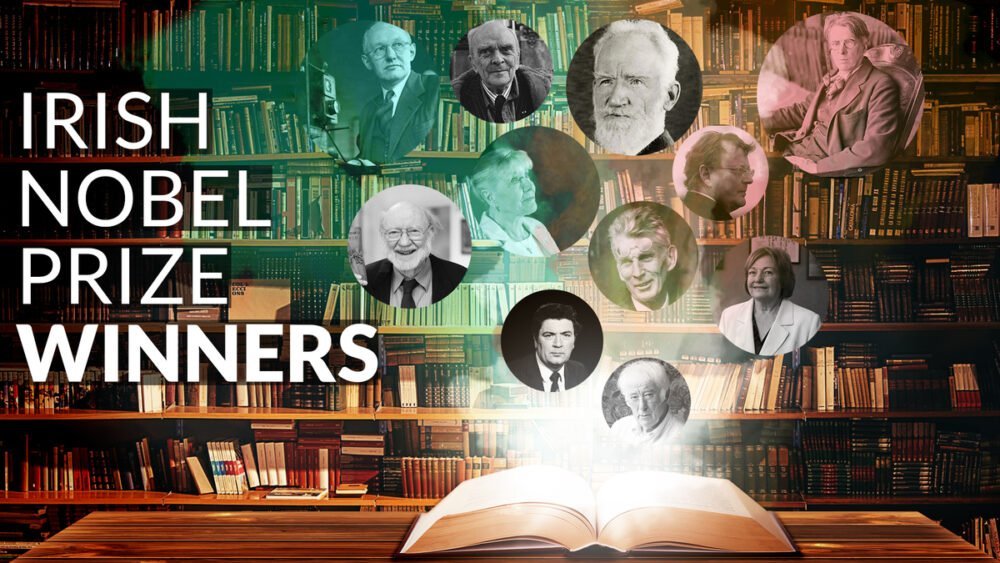
The 11 laureates profiled in this guide have connections to Ireland and Northern Ireland. Their awards cover literature, peace, physics, and physiology or medicine.
- William Butler Yeats — Literature, 1923
- George Bernard Shaw — Literature, 1925
- Ernest Walton — Physics, 1951
- Samuel Beckett — Literature, 1969
- Seán MacBride — Peace, 1974
- Betty Williams — Peace, 1976
- Mairead Corrigan — Peace, 1976
- Seamus Heaney — Literature, 1995
- John Hume — Peace, 1998
- David Trimble — Peace, 1998
- William C. Campbell — Physiology or Medicine, 2015
Read the profiles below for their achievements and Irish connections, or explore the official laureate biographies at NobelPrize.org.
William Butler Yeats (1923)
The biography of William Butler Yeats is strictly linked to the history of Irish nationalism. Both in turn provide major themes for his poetry. In the early period, he combined the use of Irish folklore with an original symbolism, influenced by his reading of the French symbolists and his edition of the works of William Blake. The middle period dates from the beginning of the 20th century: Yeats’s style became more modern and flexible, he started to conceive his symbols as a means to evoke universal myths. The late period covers the years of maturity when a new and passionate intensity.
The sense of spiritual loss led the author to attempt particularly drastic and bizarre remedies, dabbling in theosophy, spiritualism, Buddhism, reincarnation, Irish folklore, Neoplatonism, and other forms of esoteric belief, building up from these various influences a private symbolic system. Yeats’s greatness as a poet received international recognition with the award of the Nobel Prize for Literature in 1923 and he was the first Irish Nobel Prize winner.
Yeats’s imagination worked especially through the conflict and resolution of opposites: he widely employed the stylistic devices of antithesis, oxymoron, and paradox. Yeat’s vocabulary contains many words of sensual and sensory experience. Some of his most frequent images include bird imagery.
George Bernard Shaw (1925)
After a very unsuccessful debut as a novelist, he devoted himself to journalism and between 1890 and 1894 to music criticism, using the pseudonym “Corno di Bassetto”. He led strenuous battles arguing, in controversy with the repertoire of the time, for a theatre that was “a forge of thoughts, a guide of conscience, a commentary on social conduct, an armor against despair and stupidity, and a temple to the Elevation of Man”. In 1892 he began his career as a playwright. After his marriage, he devoted himself entirely to the theatre, writing dozens of highly successful works, many of them for Granville Barker’s Royal Court Theater.
In 1925 Shaw became a Nobel Prize winner for Literature, the crowning achievement of an enfant terrible, a wise desecrator who became a solid institution of nonconformity. Shaw was an exceptional playwright, master of theatrical technique, and always able to calculate and control the effect of every line. Of his comedies survive today the fluency of dialogue, the intelligence and vivacity of debate, the acute characterization of the characters: they are the modern version of the eighteenth-century “Comedy di manners”.
Ernest Thomas Sinton Walton (1951)
Ernest Walton was an Irish experimental physicist who shared the 1951 Nobel Prize in Physics with John Cockcroft. Their accelerator made it possible to study nuclear reactions using fast-moving particles. In 1932 they bombarded lithium with protons, splitting lithium nuclei into two alpha particles. This is the experiment often described as “splitting the atom”.
The award recognised their work on transforming atomic nuclei using artificially accelerated particles. Read the Nobel account of the joint experiment and Walton’s Nobel lecture.
Samuel Beckett (1969)
He developed into such a profoundly introverted and unhappy man. He moved abroad as a young man, making his permanent home in Paris, where he was for a time part of the circle of James Joyce. He was awarded the Croix de Guerre for taking part in the French Resistance. He began writing fiction in the 1930s. He achieved fame in 1953 with Waiting for Godot, as a mere relaxation from the serious business of his fiction, and of no special merit. This play presents his essential vision of life as a series of desperate distractions from the recognition of the absence of meaning. He dispensed in the end not only with any kind of dramatic action in the commonly accepted sense of the term, but even with what we would ordinarily call characters. His prose works exhibit a similar development: have some of the recognizable features of traditional novels, closer to being monologues in which the single narrative voice enunciates its despairing sense of the futility of existence. He won the Nobel Prize for Literature in 1969 also seems strange, given that the terms of reference for that award include the writer’s offering an ennobling vision of human life.
Seán MacBride (1974)
Seán MacBride was a politician. He founded and collaborated with many international organizations including the United Nations, the Council of Europe and Amnesty International. In 1946 MacBride founded the Clann na Poblachta, a socialist and republican party, for which he was constantly re-elected to parliament from 1947 to 1957. MacBride served as President of the Commission of Ministers of the Council of Europe from 1949 to 1950 and gave a strong impetus to the creation of a European Convention for the Protection of Human Rights and Fundamental Freedoms. In his 1974 Nobel lecture, he called for general and complete disarmament. MacBride fought for the External Relations Act and the Declaration of the Republic of Ireland of 1949 whereby the Free State of Ireland left the Commonwealth and became the Republic of Ireland. MacBride was a founding member of Amnesty International of which he was also an international president. He was Secretary General of the International Commission of Jurists from 1963 to 1971 and was elected President of the International Peace Bureau. He was also Vice-President of the Organisation for European Economic Cooperation (OECE, now OECD). He wrote the Constitution of the Organization of African Unity and the first Constitution of Ghana, the first African country under British rule to gain independence. He became a Nobel Prize winner for Peace in 1974, the American Medal for Peace in 1975, the Lenin Peace Prize in 1975-1976, and the UNESCO Silver Medal in 1980.
Contemporary Irish literature – from 60s until today
William Cecil Campbell (2015)
William C. Campbell was born in Ramelton, County Donegal, in 1930. He graduated from Trinity College Dublin and completed his doctorate at the University of Wisconsin. His research contributed to the development of avermectin-based treatments for parasitic infections.
Campbell and Satoshi Ōmura shared half of the 2015 Nobel Prize in Physiology or Medicine for their work on treatments against roundworm parasites; Tu Youyou received the other half for a malaria therapy. See Campbell’s official Nobel profile.
John Hume (1998)
John Hume is considered one of the most important figures in the recent history of Northern Ireland and one of the main architects of the peace process in that region. Founder and leader of the Social Democratic and Labour Party (SDLP). He was the second leader of the Social Democratic and Labour Party (SDLP), a position he held from 1979 until 2001. He served as a Member of the European Parliament and a Member of the United Kingdom Parliament and a member of the Northern Ireland Assembly. He and David Trimble received the Nobel Peace Prize in 1998 on the following grounds: “their commitment to the peace agreement for Northern Ireland and their efforts to find a political solution in the troubled province”. He is regarded as one of the most important figures in Ireland’s recent political history and one of the architects of the peace process in Northern Ireland. He is also a recipient of the Gandhi Peace Prize and the Martin Luther King Award, the only recipient of the three most important peace awards. In 2010 he was named “Ireland of the Greatest” in an Irish public survey RTÉ national broadcaster to find the greatest person in the history of Ireland. In 2012, Pope Benedict XVI made Hume Knight Commander of the State of the Church of the Order of St. Gregory the Great.
David Trimble (1998)
David Trimble was a Northern Irish politician. He was a protestant leader, secretary (1995-2005) of Northern Ireland’s largest party, the Ulster unionist party. Prime Minister of the Ulster government from 1998 to 2002. In 1998 he was awarded the Nobel Peace Prize together with J. Hume for his courage and efforts to find a solution to the Northern Ireland conflict. In 2006 he joined the House of Lords and was appointed Baron; in 2007 he joined the Conservative Party.
Apps like Duolingo make lockdown the time to learn a language
Séamus Heaney (1995)
Seamus Heaney was an Irish poet. He has stood out for his sobriety and rigorous technique of language and a poetics constantly crossed by political commitment. The evocative lyricism of the first collections is followed by the political commitment of North (1975), supported by faith in the saving power of collective memory and the work of the poet. In Station Island, a sort of Dantean purgatory, Heaney retraces the history of Ireland meeting old masters and fellow travellers. He has increasingly focused on an “aggressively updated” reading, in his words, of the degraded landscape of the contemporary world, with particular attention to the linguistic corruption that derives from the trades and commerce of international capitalism. The fabric of the verse appears crossed by rhythmic and stylistic ambivalences, in an emphasis on the technical and self-referential dimension of poetry that H. likes to take up again in his theoretical reflections. In 1995 he was awarded the Nobel Prize for Literature. The speech given by Heaney on the occasion of the award is published under the title Crediting poetry: the Nobel lecture (1996). His collections include Door into the dark, North, and The spirit level.
Mairead Corrigan (1976)
Mairead Corrigan Maguire helped establish the Peace People after the deaths of her sister’s three children in Belfast in August 1976. The children were struck by an out-of-control car after its driver was shot; they were not killed by the shooting itself. Corrigan, Betty Williams and journalist Ciaran McKeown worked together to organise a movement against violence.
Corrigan and Williams shared the 1976 Nobel Peace Prize, which was presented in 1977. In her Nobel interview, Corrigan explains how the movement began.
Betty Williams (1976)
Betty Williams was a Belfast peace campaigner and co-founder of the Peace People. She helped mobilise public opposition to the violence in Northern Ireland, working alongside Mairead Corrigan and Ciaran McKeown.
Williams and Corrigan were jointly awarded the 1976 Nobel Peace Prize for their efforts to build a movement to end the conflict. The prize was presented the following year. See the official 1976 award record.