
Les Lacs du Connemara: The French Song About Ireland
 by Laurine Tiran
 by Laurine Tiran
Babylon Radio
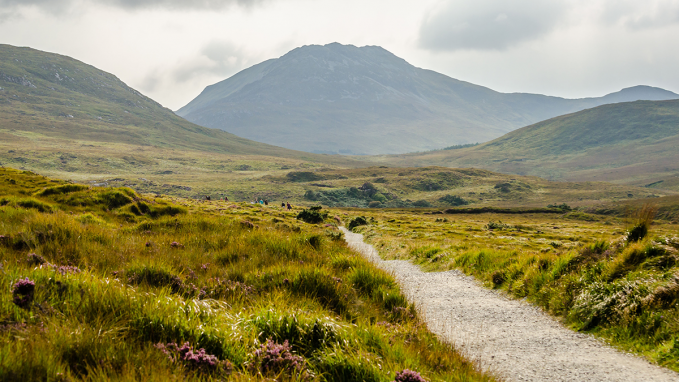
Listen nowImage credit: “Connemara National Park” by banjipark
“Les Lacs du Connemara” is Michel Sardou’s French song about Ireland from 1981. Its title means “The Lakes of Connemara”. The words are credited to Michel Sardou and Pierre Delanoë, with music by Jacques Revaux, as recorded in the Bibliothèque nationale de France catalogue.
The song creates a dramatic, imagined picture of Ireland through landscape, a wedding celebration and references to history. It is a work of storytelling, rather than a reliable guide to Irish geography. Here is a closer look at its sound and appeal.
Who wrote the song?
Sardou and Delanoë supplied the lyrics and Revaux the music. Stories about a malfunctioning synthesizer and a travel brochure are often repeated in accounts of its creation. Without a direct source for the details, those anecdotes should be treated separately from the catalogue’s verified authorship and date.
An atmosphere created by the music
Have you listened to the song, yes? Let’s first talk about the music itself and the atmosphere it creates. The bagpipes do a lot to set the scene and put you in the right mood. Then there are the variations, little things that make the song special. It’s a very long song (6:02 minutes) but it’s not boring because the rhythm keeps changing.
During the slow parts, you dive into a story that sounds epic or glorious. The voice is strong, you can guess that it is serious. One may argue about this, but music is a lot about mood and atmosphere, and the grave verses of the song work well on that point. You almost want to sing at the top of your lungs with the singer, with a hand on your heart and passion in your voice.
That’s it! Now, you’re a knight. I don’t set the rule, it is what it is.
But then come the quick parts, and here you are in for a run, because if you want to sing with him, you’d better be fast. You leave behind the grave tones for most joyful and lively ones. The voice still sounds serious (because it’s Michel Sardou, if you have heard any other songs you know that he almost always sounds serious) but you can finally dance. You can sing the la-la-la parts too, feeling the rhythm quicken as you speed up too. There is no more to say about the music, except that it is very well done, and keeps you up and interested through the whole song. Now let’s take a look at the lyrics.
What is the song about?
The opening imagines a harsh landscape before the music turns towards a wedding celebration. Names and places help create a recognisably Irish setting for a French-speaking audience. The changing pace moves the listener between reflection and celebration.
The story also reaches beyond Connemara, mentioning places elsewhere in Ireland and drawing on religious and historical themes. It is better understood as a French songwriter’s imagined Ireland than as a literal account of one region.


The lyrics return to conflict, peace and the idea of belonging. Those themes sit beside the energy of a communal celebration, helping explain why listeners can respond to the music even without following every reference.
But why is it so famous?
The song has remained familiar to listeners long after its 1981 release. Why does it work so well as a singalong? The reason is more surprising: the song is very popular in all kinds of parties, even student parties where most of the people weren’t born when the song was released. And especially in renowned schools like HEC (a very famous French business school), where the song is even played at the end of the graduation ceremony.
[wpdevart_youtube caption=”” align=”left”]HtDdeWxHPio[/wpdevart_youtube]
All that we’ve already said about the music, the variations, the rhythm, and the lively lyrics could be a part of the explanation, but it’s surely not enough, because nobody really knows what makes this song so popular. At wedding parties, it may be because the traditional French uncle is an eternal fan of Michel Sardou. But at student parties?
The French newspaper Le Parisien published an article on its website in 2019 trying to explain this strange phenomenon by asking students why the song was so important to them. For Hugo, former head of the students’ office at the Catholic Law University of Lille, the song has a sort of unifying power for drunk people, who end up jumping to the spot “like a herd of animals”.
By interviewing two DJs, one from the Paris area and one from the south of France, the article also shows us that the song is popular in clubs all over the country and that people even request it, because it has a sort of social aspect: nobody can dance on their own when the song starts. The article points out that the song is also the last way to let off steam during a party before going home, because no song can have the same impact after this one.
In conclusion, it’s very difficult to point to a single reason why this song is so famous, decades after its first release. Unfortunately, we can doubt that the Irish narrative has a part to play, but the Celtic sound is surely one of the reasons for its success.
Now you know about this strangely popular French song about Ireland! Did you know about it before reading this article? Let us know what you think about it in the comment section!