
Canadian Citizenship by Descent After Bill C-3: What Families Abroad Need to Know
 by
Babylon Radio
Listen nowCanada has changed the rules on passing citizenship to children born or adopted abroad. Bill C-3, An Act to amend the Citizenship Act (2025), received royal assent on 20 November 2025 and came into force on 15 December 2025. It removes the old “first-generation limit” in many cases. Here is what the change means for families living outside Canada, and how to prove your status.
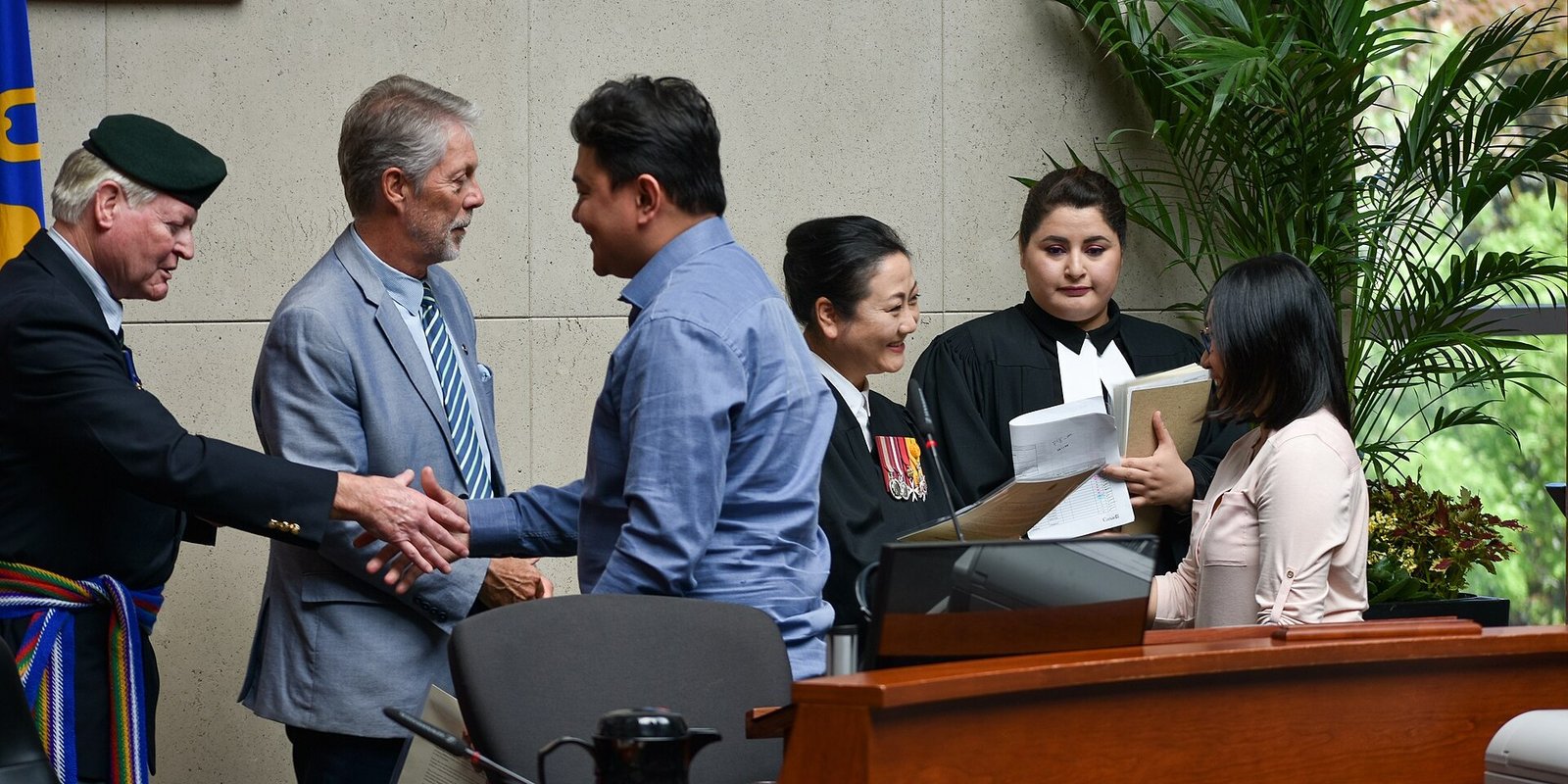
Archive photograph: a citizenship ceremony in Hamilton, Ontario, 14 June 2019. Illustrative image, not a Bill C-3 ceremony. Photo: Joey Coleman / Wikimedia Commons, CC BY-SA 2.0 (cropped).
What was the first-generation limit?
Before Bill C-3, a Canadian citizen could generally pass on citizenship to a child born abroad, or use the direct grant for a child adopted abroad, only if the parent was born in Canada or naturalised in Canada before the child’s birth or adoption. In December 2023 the Ontario Superior Court of Justice found parts of this rule unconstitutional, and the Government of Canada did not appeal. Bill C-3 is the law that replaced it.
IRCC counts generations like this. The first generation is the first person born or adopted outside Canada to a Canadian citizen who was born in Canada or naturalised. The second generation or later is someone born or adopted outside Canada to a first-generation parent. This means a parent being born abroad does not on its own decide the outcome. How that parent became Canadian matters too: for example, a parent who was born abroad but later naturalised in Canada will generally have a child born abroad in the first generation, rather than the second. Special historical rules can affect some cases.
Born abroad before 15 December 2025
If you were born outside Canada before 15 December 2025 to a parent who was a Canadian citizen at the time, IRCC says you are in most cases now automatically a Canadian citizen, even if you are in the second generation or later. This also covers people born to a parent who became Canadian because of the same changes. No substantial connection test applies to this group.
Anyone who was already a citizen before Bill C-3 stays a citizen. The law also restores citizenship to people who lost it under the former section 8 of the Citizenship Act, which required some people born abroad to apply to keep their citizenship. If you became Canadian automatically under the new law, were not previously granted citizenship, and do not want it, there is a simplified process to give it up (renounce it).
Born or adopted on or after 15 December 2025: the 1,095-day test
For children born or adopted abroad on or after 15 December 2025 in the second generation or later, the Canadian parent generally needs at least 1,095 days of physical presence in Canada in total before the birth or adoption. The rule is set out in sections 3(3) and 5.1(4) of the Citizenship Act, and IRCC calls it a “substantial connection” to Canada. Some points to note:
- The 1,095 days are cumulative. They do not need to be continuous.
- It is the parent’s time in Canada that counts, not the child’s.
- The days must have been spent in Canada before the birth or adoption. Time spent afterwards does not count towards that child.
- The test does not apply to children born or adopted before 15 December 2025.
There is an exception for some families in Crown service abroad. Under sections 3(5) and 5.1(5) of the Act, the test does not apply where a parent, or that parent’s own parent, was employed outside Canada with the Canadian Armed Forces, the federal public administration or a provincial public service at the time set out in the Act (for example, at the time of the child’s birth or adoption). Locally engaged staff are excluded.
The parent’s time in Canada is shown when applying for proof of citizenship for a child born abroad, or when applying for citizenship for an adopted child. IRCC gives school enrolment records or transcripts and border entry or exit records as examples of possible proof. Families who expect to rely on this test may find it useful to keep such records safe now.
Adopted abroad: a separate grant application
Adoption works differently. A person adopted abroad does not become a citizen automatically. Instead, a separate application is made for a direct grant of citizenship for the adopted child under section 5.1 of the Citizenship Act. Other adoption eligibility requirements still apply; meeting the 1,095-day rule alone does not guarantee a grant.
- Adopted before 15 December 2025: people born and adopted outside Canada by a Canadian parent, including in the second generation or later, are likely eligible to apply for the direct grant.
- Adopted on or after 15 December 2025: in the second generation or later, the Canadian parent generally needs the 1,095 days in Canada before the adoption, subject to the Crown service exception above.
How to prove your citizenship
If you think you became a citizen because of Bill C-3, IRCC says you must apply for a citizenship certificate to find out for sure. The certificate is proof of Canadian citizenship and helps when applying for a Canadian passport and at the border. Adoptive parents follow a separate route: the application for citizenship for an adopted child, not the certificate application.
If you already applied for a certificate under the earlier interim measure and it is still in progress, IRCC says it will be processed under the new rules and you do not need to reapply.
Asking for urgent processing
IRCC may process a citizenship certificate faster in some cases, such as a job or a place at school, access to social benefits, or a case of statelessness. Travel because of a death or serious illness in the family may qualify if you cannot get a passport in your other nationality. A request needs an explanation letter and supporting documents, and incomplete applications are not processed. Even an approved urgent request is not guaranteed to be finished in time.
Rules can change and every family’s history is different. For your own case, check IRCC’s “Check if you may be a citizen” tool or speak to a regulated Canadian immigration professional.